Rifle and Saber* is a grand tactical system. It is “tactical” because combat is by ranged fire and close assault, not by comparing total combat strength and rolling on a CRT. It is “grand” in that each game covers a whole battle, so an operationally significant outcome occurs. We aren’t just trying to capture a stone farmhouse.
Rifle and Saber descends from tactical game systems such The Tactical Game Series (TCS) from the Gamers, and the La Bataille System. It differs in that I wanted to de-emphasize the fine details of movement and fire, will emphasizing a clear yet simple orders system. TCS has an interesting rules system, but for many players it is too ambiguous. The versions of La Bataille that existed when I started design had no orders system, so the key thing that enabled to French to win so often (a responsive and flexible command structure) was just not in the game.
In the end I was not able to remove all the detail from fire and movement because players wanted it, and – especially at Gallipoli – the fine details of terrain matter and drive the higher level plans.
Movement is fairly standard. Movement points (MP) are not printed on the counters because they are the same for all units of the same class – infantry have six MP. Belleau Woods is unusual in that all the on-map units move as infantry.
Stacking limits are high, but in practice you need to spread out. Fire has positive bonuses for big stacks, so it is dangerous to concentrate. Machine guns have zero points for stacking – concentration of fires not people is important.
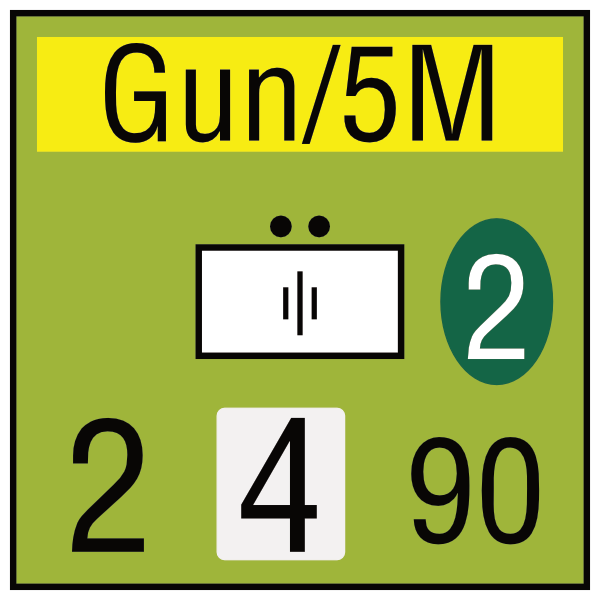
Fire is one-hex range for rifle infantry, four hexes for machine guns (MGs) with diminishing efficiency at range, and typically one to three hexes for mortars and infantry guns. The fire points are the left-most number on the counter, MG points are the center, morale is the right-hand number. Only one rifle company can fire through a hexside, plus another 16 points of machine guns. The great advantage of machine guns is that they do not count for stacking, but they cannot assault (too heavy).
Fire is either commanded fire (a group of friendly units gang up on one enemy stack), or opportunity fire (one stack fires in response to enemy movement or other actions). Commanded fire occurs just before movement. Opportunity fire is deadlier – there are strong modifiers for firing at moving units, especially in the early battles when the US forces were still using 1914 wave formations. The more movement points a unit spends to enter the hex, the bigger the DRM. Opportunity fire takes place either in the hex that the unit is entering, or in the hex that it is leaving. A moving stack can be fired at either by all adjacent stacks, or one remote stack. An on-map artillery unit can fire only once against any one moving stack. The target stack completes its movement, and then the artillery chooses in which hex to fire
Fire is resolved on the Fire Table. Add up the Fire Points and Fire Shifts, cross reference on the fire table and roll percentile dice. The result in will be a decimal fraction such as 1.19 or 0.56. Whole numbers are automatic hits (1 and 0 in this example). Compare the percentile dice against the decimal fraction. If the percentile roll is below the fraction, then it is an extra hit. Infantry Fire value is doubled at range zero (i.e., in the same hex), artillery varies. Every fire causes the target stack to make a morale check, another percentile roll.
By 1918 most artillery is hidden and well away from the battlefield. So unlike Gallipoli and Mons, there are very few artillery units on the map – only mortars and infantry guns directly attached to infantry battalions. Off-map Artillery shows the sophisticated methods developed by 1918, it isn’t just “fire points against a hex.” Off-map artillery has many different kinds of fire – Creeping Barrages, Annihilation Fire, Raking, Harassment and Interdiction, Box Barrages, and SOS (on-call defensive). These barrages are pre-plotted for attacks but is more responsive on defense – the difference is due to the lack of radios and therefore the reliance on telephone lines.Every hit causes an officer point to be lost (below) and a morale check (below).
By 1918 the armies varied tremendously. The US Army was at full strength and the units very uniform. The German army varied considerably in quality and quantity – there are 2nd through 4th class German divisions present with varying numbers of troops. Rifle units have multiple steps, so a unit is typically represented by a full-strength and one or two reduced strength versions, which allows for four to six steps and good legibility.
Terrain and Line of Sight. There are three grades of Line of Sight – Open, Partial, and Blocked. Higher elevation between firer and target block line of sight. Military crests block line of sight into the “ravines” below them, whereas simple contour changes are “smooth” and do not affect line of sight. Woods and Villages block Line of Sight.
Hiding: All units can hide in close terrain. A unit that is hiding cannot fire, but it is immune to infantry fire from its own elevation or lower and better protected against shrapnel. But it cannot fire – hiding means giving up fire dominance
Assault is how you actually drive someone out of a hex. During the movement phase, an assaulting stack makes a pre-assault morale check, and spends an officer point. If it passes, then it enters the hex and receives opportunity fire. Assault is resolved using the assault table. Add up the assaulting fire points (rifle infantry only, no artillery or MGs), and the defender’s points (MGs and low-angle artillery). For the first round only, apply all row and column shifts from the Assault Shifts Table. Cross-reference into the table and roll percentile – the table will tell you who takes the first hit. Each round will produce a hit on one side or another. After each round each side has the option to withdraw, Attacker choosing first. Withdrawing units take opportunity fire, but the fire value is not doubled. Assault is much bloodier and decisive than fire combat due to the multiple rounds.
Us vs Them is a special case of hiding where both players have units hiding in the same hex. Us/Them is created when one side breaks off an assault in a close terrain hex. A hiding unit can “pop its head up” and fire, but the instant it does so it receives opportunity fire from any eligible stack before its own fire is resolved. Units outside of an Us/Them hex cannot fire into that hex.
Morale is fairly standard – the rightmost number on the counter is the morale (base 100). Higher numbers are better. A
stack must make a morale check after every loss and to enter an assault. Use the best unit in the stack and apply the
DRMs. If it fails (rolls high) it becomes confused. If moving it stops. If it is already confused and fails, then it loses an dditional step as men drift away.
Command and Army Organization Players command their forces using command elements, which are Battalions in Belleau Wood. Every infantry unit belongs to a Command Element. All units of a Command Element have the same colored bar at the top of the counter. Command elements have orders, activate one a time, and have officer points. The orders type (attack, defense, etc.) and officer points are tracked on the Army Status Display. Each type of orders allows certain kinds of movement and actions. For example, assaults are only allowed on attack orders, digging trenches require a defense order, and a regroup order allows the recovery of step losses.
Orders can be voluntarily changed and can involuntarily fail. Perform both actions during the command phase at the beginning of each turn. The more officer points that a Command element has lost, the harder it is for it to change voluntarily, and the more chance that it will fail its orders. Command elements with general reserve orders can easily change orders, whereas an attack order is difficult to change (nobody knows where the Colonel is!). The objectives routes of march for an order are drawn on the planning maps. Command elements gain a small number of officer points each
turn, depending on their order type. A Command Element can only regain up to half its original officer points, unless it uses a regroup order.
Command elements are activated one at a time, according to a modified chit pull. Each side rolls a die, the lower moves. Depending on a second sequencing roll the player choose randomly or might choose which command clement moves.
Officer points track the exhaustion and loss of the low-level officers, NCOs, and runners. An officer point is lost for every step loss, assault attempt, and various other dangerous activities.
Experienced players are most concerned with the officer point status of their command elements and keeping track of who has command elements still in general reserve. Especially in the campaign scenario, the game is about conserving your forces and confusing the opponent. If you are the last one with an uncommitted reserve, then you have the chance to land a decisive blow and win the game.